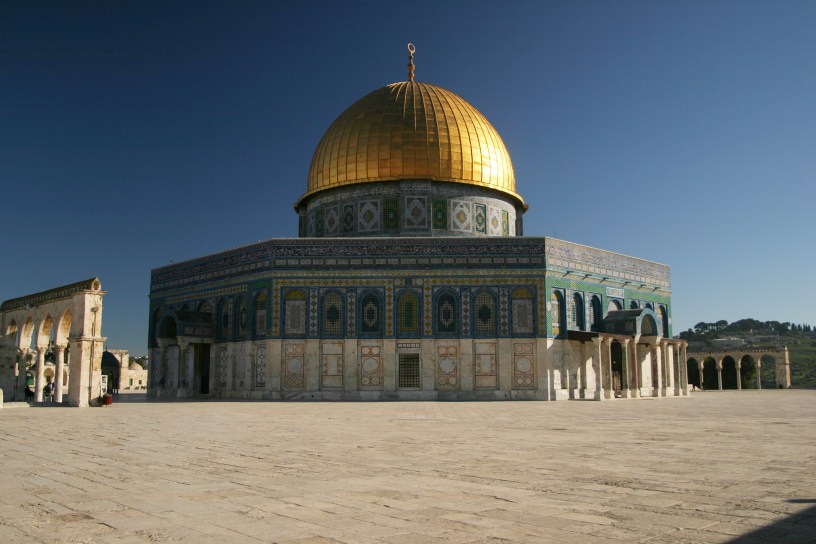
In the year 15 H (637/8 CE), the Muslims liberated Jerusalem from the Byzantines. The Muslim army, led by Abu ‘Ubaydah and including Khalid b. Walid, laid siege to the city and waited it out until the Christians surrendered. The Greek Orthodox Patriarch and Byzantine government representative, Sophronious, insisted that he would only hand over the key to the Holy City to the Caliph ‘Umar (ra) himself, who was in Madina. Upon hearing of this request, the Amir al-Mu’minin set off for Jerusalem on only one donkey for the long journey, taking it in turn with his servant to ride while the other walked. He wore simple robes and upon arriving in Jerusalem, the Patriarch was amazed that the Caliph, one of the most powerful men in the world, was almost indistinguishable from his servant. Sophronious gave ‘Umar (ra) a tour of the city ending with the Church of the Holy Sepulchre. When it was time to pray, the Muslims were offered a place in the church to perform salah. But ‘Umar (ra) refused out of fear that Muslims in the future may permanently use the site as a place of worship. So they prayed nearby at al-Aqsa.
As had been done for other cities which had been conquered, the Muslims drew up an agreement detailing the rights of the people of Jerusalem and guaranteeing them safety and protection. This became known as the ‘Umari Treaty, and was signed by some of the generals of the Muslim army.
Different versions of the text of the pact are related by al-Ya‘qubi (d. 284 H), Ibn al-Batriq (d. 328 H), al-Bayhaqi (d. 458 H), Ibn ‘Asakir (d. 571 H) and Ibn al-Jawzi (d. 597 H). The text below is recorded by al-Tabari in his Tarikh al-Rusul wa al-Muluk (cf. The History of al-Tabari – An Annotated Translation Volume XII: The Battle of Qadisiyyah and the Conquest of Syria and Palestine, State University of New York, Albany, 1992, pp. 191-192):
In the name of Allah, the Compassionate, the Merciful. This is the assurance of safety (aman) which the servant of Allah, ʿUmar, the Amir al-Mu’minin, has given to the people of Jerusalem. He has given them an assurance of safety for themselves, for their property, their churches, their crosses, the sick and healthy of the city and for all the rituals which belong to their religion. Their churches will not be inhabited by Muslims and will not be destroyed. Neither they, nor the land on which they stand, nor their cross, nor their property will be damaged. They will not be forcibly converted. And [as per the Christians’ request] Jews will not live in the same areas as them.
The people of Jerusalem must pay the taxes like the people of other cities and must expel the Byzantines and the robbers. Those of the people of Jerusalem who want to leave with the Byzantines, take their property and abandon their churches and crosses will be safe until they reach their place of refuge. The villagers [who had taken refuge in the city at the time of the conquest] may remain in the city if they wish but must pay taxes like the citizens. Those who wish may go with the Byzantines and those who wish may return to their families. Nothing is to be taken from them before their harvest is reaped.
If they pay their taxes according to their obligations, then the conditions laid out in this letter are under the covenant of Allah, are the responsibility of His Messenger ﷺ, of the Caliphs and of the Believers.
Witnessed by: Khalid b. Walid; ‘Amr b. al-‘As; ‘Abd al-Rahman b. ‘Awf and Mu‘awiya b. Abi Sufyan.
بسم الله الرحمن الرحيم، هذا ما أعطى عبد الله أمير المؤمنين عمر، أهل إيليا من الأمان، أعطاهم أمانًا لأنفسهم وأموالهم ولكنائسهم ولصلبانهم ومقيمها وبريئها وسائر ملتها، إنها لا تسكن كنائسهم ولا تهدم ولا ينتقص منها ولا من حدها ولا من صلبانهم، ولا شيء من أموالهم، ولا يكرهون على دينهم، ولا يضار أحد منهم، ولا يسكن بإيليا معهم أحد من اليهود، وعلى أهل إيليا أن يعطوا الجزية كما يعطي أهل المدائن على أن يخرجوا منها الروم واللصوص، فمن خرج منهم فهو آمن على نفسه وماله حتى يبلغوا مأمنهم، ومن أقام منهم فهو آمن وعليه مثل ما على أهل إيليا من الجزية، ومن أحب من أهل إيلياء أن يسير بنفسه وماله مع الروم، ويخلي بيعتهم وصليبهم، فإنهم آمنون على أنفسهم وعلى بيعتهم وصليبهم حتى يبلغوا مأمنهم، ومن كان فيها من أهل الأرض، فمن شاء منهم قعد وعليه مثل ما على إيليا من الجزية، ومن شاء سار مع الروم، ومن شاء رجع إلى أرضه، فإنه لا يؤخذ منه شيء حتى يحصد حصادهم، وعلى ما في هذا الكتاب عهد الله وذمته، وذمة رسول الله صلى الله عليه وسلم وذمة الخلفاء وذمة المؤمنين، إذا أعطوا الذي عليه من الجزية. شهد على ذلك خالد بن الوليد، وعمرو بن العاص، وعبد الرحمن بن عوف، ومعاوية بن أبي سفيان.
After the signing of this treaty, the Caliph allowed the Jews to pray at their places of worship (after being banned by the Byzantines from doing so for much of the previous 500 years).
The Christians had been using the site of al-Aqsa as a rubbish dump, so ‘Umar (ra) and the Muslims cleared the area and the Masjid was built there. Under his rule and that of the Caliphs after him, Jerusalem became a major centre of pilgrimage and trade. For the next 462 years, Muslims guaranteed the right of minorities to live and worship there as promised in the ‘Umari Treaty. This is in stark contrast to how the Crusaders behaved when they captured the city, for when the Crusaders seized Jerusalem in 492 AH / 1099 CE, they carried out a mass slaughter of the city’s inhabitants.
Classical Muslim historians describe the event in stark detail:
- Ibn al‑Athīr (d. 630 AH) writes: “فَقَتَلَ الإِفْرَنْجُ بِالقُدْسِ أَكْثَرَ مِنْ سَبْعِينَ أَلْفًا مِنَ المُسْلِمِينَ” “The Franks killed in Jerusalem more than seventy thousand Muslims.” al‑Kāmil fī al‑Tārīkh, 10/186.
- Ibn al‑Qalānisī (d. 555 AH) reports that the Crusaders “أَفْنَوْا أَهْلَهَا قَتْلًا وَسَبْيًا” “annihilated its people through killing and enslavement.” Dhail Tārīkh Dimashq, p. 168.
- Imād al‑Dīn al‑Iṣfahānī (d. 597 AH), an eyewitness to the later Muslim reconquest, summarises the earlier Crusader conquest by saying: “وَجَرَتْ يَوْمَئِذٍ مَذَابِحُ لَمْ يُسْمَعْ بِمِثْلِهَا” “Massacres took place that had never been heard of before.” al‑Fatḥ al‑Qussī, p. 32.
Contemporary Latin chronicles corroborate this, describing blood “up to the ankles” in the streets of Jerusalem. The Crusaders also seized the Islamic holy sites: al‑Aqsa was converted into the headquarters of the Templars, and the Dome of the Rock was turned into a church.
Thus, while the Muslims under ʿUmar guaranteed the rights of all communities to live and worship in Jerusalem, the Crusader conquest was marked by indiscriminate killing, expulsion, and the transformation of Islamic sacred spaces into Christian institutions.
 The Caliphate
Assalamu alaikum Brother
I pray you’re well.
I have been looking for a reference for this part … > > After the signing of this treaty, the Caliph allowed the Jews to pray at their places of worship such as the Wailing Wall (after being banned by the Byzantines from doing so for much of the previous 500 years). > ”
Do you have a reference for it?
AW
>
Wa ‘alaykum salam wa rahmatu’Llah.
I am well my brother – how are you?
The reference is Lost Islamic History by Firas Alkhateeb. The book is available on the Internet Archive and the relevant section begins on page 34 of that version.
Wassalam,
Abdul Malik
Alhamdulillah
All is well
Jzk
>
Please refer to this article:
Western Wall – Wikipedia